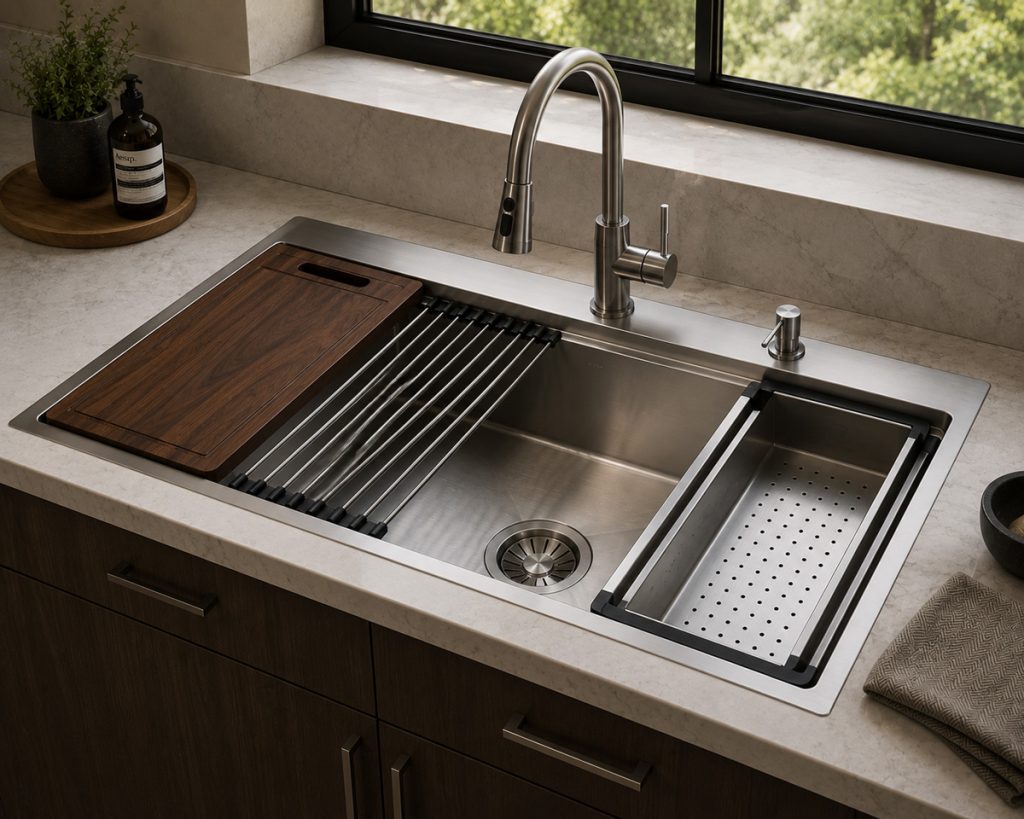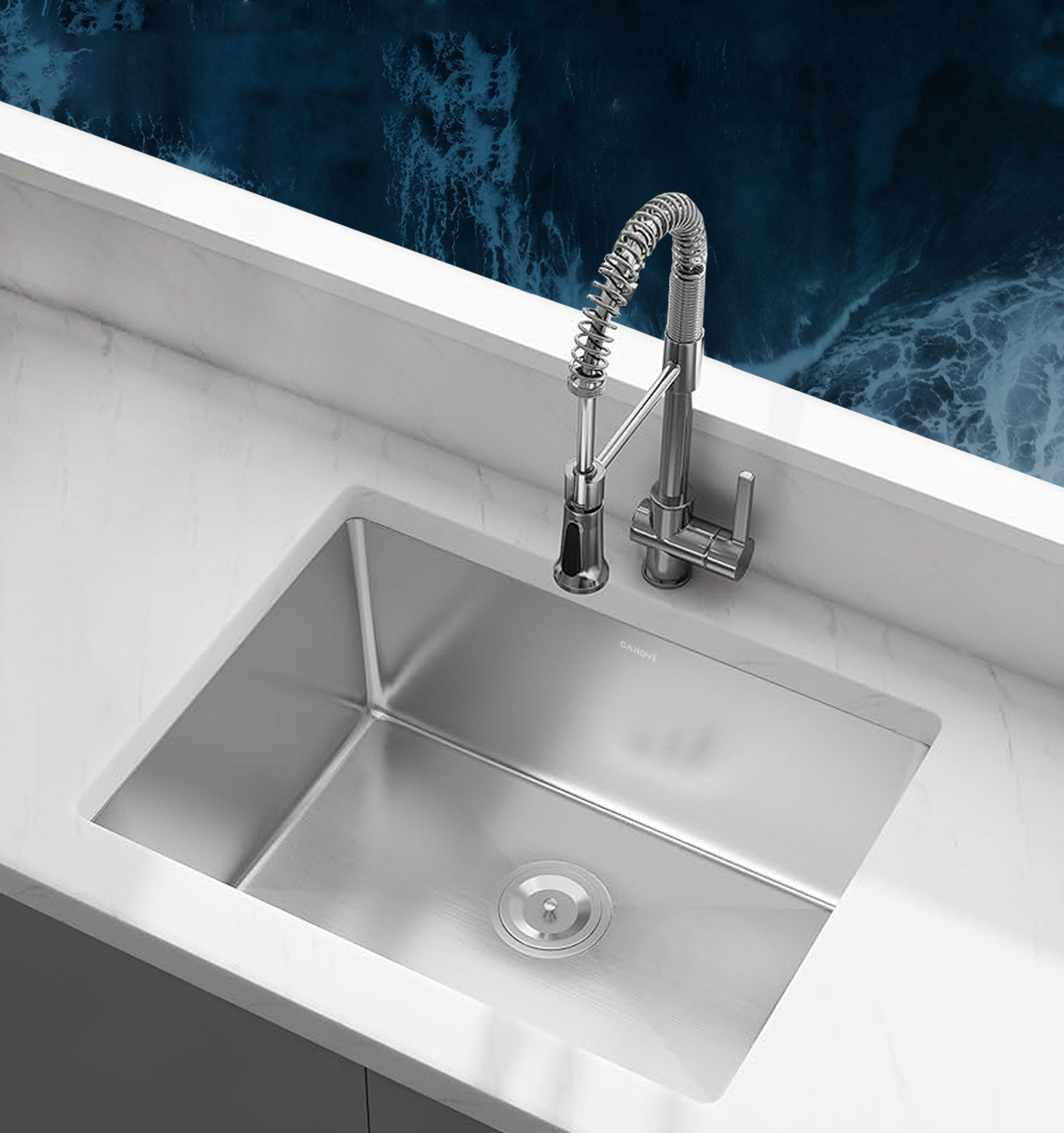


When designing a modern luxury kitchen, the sink is far more than a simple utility basin; it is the central operational hub of the entire space. As open-concept homes and professional-grade residential cooking continue to dominate contemporary architecture, homeowners and interior designers are scrutinizing every detail of kitchen fixtures. Among the vast array of available materials, configurations, and manufacturing styles, handmade stainless steel sinks have emerged as the definitive standard for high-end kitchens.
Understanding the difference between mass-produced stamped sinks and precision handcrafted steel fixtures allows homeowners to make an investment that delivers unmatched aesthetic elegance, functional superiority, and structural permanence. In this guide, we explore the art of handcrafted steel manufacturing, the science behind heavy-gauge alloys, and the proprietary engineering innovations that elevate a handcrafted sink into a lifetime fixture.
1. Handcrafted Precision vs. Mass-Produced Stamping
To appreciate the true value of a handcrafted sink, one must first understand how conventional sinks are manufactured. The vast majority of entry-level and builder-grade stainless steel sinks are produced using automated mechanical stamping. In this mass-market process, a thin sheet of metal is forced into a mold by a high-pressure hydraulic press.
While stamping allows for rapid, low-cost production, it introduces significant material and structural compromises:
- Uneven Sheet Wall Thinning: Stretching a single sheet of metal into a deep basin shape forces the steel to thin out significantly around the bottom corners and sidewalls. A sink that starts as 18-gauge steel on top may end up as thin as 20-gauge or 22-gauge at the base, making it highly vulnerable to denting and flexing.
- Rounded Slopes and Restricted Volume: Stamping presses require wide, sloped radii to prevent the metal from tearing during deep drawing. This results in curved sidewalls that reduce usable basin volume and prevent large cookware from sitting flat.
- Thin, Noisy Profiles: Stamped sinks rely on lightweight metal sheets that easily transmit the harsh clatter of running water, dropped utensils, and garbage disposal vibrations.
The Handcrafted Advantage
In contrast, a handmade stainless steel sink is fabricated through precision cutting, architectural folding, and expert hand-welding. Rather than stretching the metal under extreme pressure, thick stainless steel sheets are cut to exact tolerances and folded into clean, structural profiles.
This handcrafted approach preserves the exact nominal thickness of the metal across every surface of the basin—from the upper rim down to the lowest corner. The result is a rigid, substantial fixture that maintains its structural integrity and offers crisp, modern architectural lines such as zero-radius (R0) or refined small-radius (R10) corners.
2. Material Integrity: The True 16-Gauge Standard
In stainless steel sink manufacturing, sheet thickness is measured by “gauge” (ga), where a lower number indicates a thicker, heavier sheet of metal.
A premium handmade sink utilizes heavy-duty 16-gauge stainless steel, which measures approximately 0.0625 inches (1.59 mm) in thickness. Compared to standard 18-gauge (1.27 mm) or economy 20-gauge (0.95 mm) alternatives, 16-gauge steel provides distinct operational benefits:
- Dent and Impact Resistance: Heavy Dutch ovens, cast-iron pans, and heavy stoneware can easily dent or warp thin steel sheets. A 16-gauge handcrafted basin absorbs high-impact drops without structural deformation.
- Torque Resistance for Disposals: High-horsepower garbage disposals create significant rotational torque. Thicker steel prevents flexing around the drain flange, maintaining a watertight seal over decades of daily use.
- Rock-Solid Accessory Support: For workstation layouts featuring integrated accessory tracks, thick steel walls ensure that heavy walnut cutting boards and loaded colanders remain completely stable without sagging.
The CanuckCaliper Standard
A common industry shortcut involves measuring sink thickness after applying heavy synthetic undercoatings or thick paint sprays to obscure thinner metal. At Canovii, our commitment to uncompromised material honesty is reflected in our CanuckCaliper standard. Every specified gauge reflects the true, unadulterated thickness of the raw steel sheet itself prior to any acoustic or thermal coatings, ensuring consistent performance across the entire fixture.
3. Alloy Metallurgy: TrueCore 304 vs. Marine-Grade 316
Thickness alone does not guarantee performance; the chemical composition of the steel alloy determines its resistance to chemical corrosion, rust, and everyday staining.
TrueCore 304 Stainless Steel (18/10 Composition)
The industry benchmark for indoor luxury kitchens is TrueCore 304 stainless steel, composed of 18% chromium and 10% nickel. Chromium reacts naturally with oxygen in the air to form an invisible, passive chromium-oxide layer on the metal’s surface. This protective film prevents rust formation and resists daily chemical exposure from dish soaps, food acids, and household cleaners.
TrueCore Marine-Grade 316 Stainless Steel
For outdoor kitchens, patio entertainment areas, or coastal residential properties exposed to salt air, standard 304 steel can face localized pitting risks over time. In these demanding environments, TrueCore Marine-Grade 316 stainless steel is the definitive solution. Grade 316 incorporates 2% to 3% molybdenum into the alloy, dramatically increasing resistance to chlorides, saline environments, and aggressive ambient conditions.
4. Advanced Manufacturing Technologies Behind Canovii Sinks
Craftsmanship reaches its peak when skilled hand-finishing is combined with state-of-the-art structural engineering. Canovii integrates proprietary technologies into every handmade basin to ensure lifetime reliability:
- SoloForm™ One-Piece Construction: Rather than assembling multiple thin panels, SoloForm technology utilizes a single, precision-formed sheet of premium stainless steel to form the primary basin body. This reduces unnecessary weld seams, maximizes structural strength, and presents a sleek, unified profile.
- Laser Fusion™ Precision Welding: Where specialized joints are required, advanced Laser Fusion welding creates micro-narrow, high-density structural bonds. This minimizes heat transfer during manufacturing, eliminating metal warping and post-weld grinding marks while preserving the metal’s natural grain.
- PliLock™ Interlocking Mechanics: Traditional weld-only corner joints can fail under extreme stress. PliLock technology mechanically interlocks structural components prior to fusion welding, creating unmatched joint strength at critical stress points.
- TruNordStrong™ Reinforced Flange: The mounting flange is engineered as a continuous, integral extension of the main sink body. This TruNordStrong framework ensures that undermount support clips pull against a rigid, unified structure, locking the sink securely against granite or quartz countertops.
5. Acoustic Comfort and Moisture Management
A common drawback of standard metal sinks is noisy operation and under-cabinet condensation. A luxury handcrafted sink solves both challenges through sophisticated thermal and acoustic insulation.
TaigaCore Acoustic Sound Isolation
Heavy 16-gauge steel mass inherently dampens sound far better than thin metal. To completely eliminate unwanted reverberation, Canovii applies extra-thick TaigaCore acoustic sound isolation pads to the underside and sidewalls of the basin. These high-density pads absorb vibrational energy from running water, clinking cookware, and garbage disposals, converting harsh metallic clatter into a quiet, muted thud.
ChinookShield Anti-Condensation Barrier
Temperature disparities between icy basin water and warm under-cabinet air can cause moisture droplets to form beneath the sink. Over time, this condensation drips onto wooden cabinetry, causing hidden wood rot, structural damage, and mold growth.
Our ChinookShield protective barrier coats the entire underside of the sink with a durable, moisture-resistant thermal layer. This barrier prevents condensation accumulation, protects interior cabinetry, and adds a secondary sound-dampening layer.
6. Functional Geometry: Aqua Harmony & Deep Basins
A handcrafted sink must not only look exceptional; it must perform effortlessly during heavy meal preparation and cleanup.